Architecture

Knowledge Architecture

Explore the concepts, editorial lenses, and research behind the Cognitive Debt framework.

Curated by Jim Koetting•Published: September 21, 2026

What is this architecture?

The knowledge architecture expands on the core Cognitive Debt framework. These specific editorial lenses—along with corresponding comparisons and research—explore how organizations lose access to their own intelligence and the human tax paid to recover it.

Framework answers

What Cognitive Debt means in organizations

These concise answers define the framework before you choose whether to explore its application or measure your own experience.

What is Cognitive Debt?

Cognitive Debt is the accumulated gap between what an organization and its people know and what they can reliably retrieve, trust, interpret and act upon when the moment requires it. Its interest is paid through repeated decisions, unclear ownership, unnecessary meetings, lost context, duplicated work and slower execution. Read the full definition and examples.
What causes Cognitive Debt?

Cognitive Debt accumulates when decisions are not preserved, ownership remains ambiguous, knowledge is trapped in people or disconnected systems, information cannot be trusted, meetings fail to create durable clarity and fragmented attention encourages short-term workarounds instead of lasting solutions. See how those causes become operating costs.

How is it different from technical debt?

Technical debt describes the future cost created by shortcuts and accumulated complexity in software. Organizational Cognitive Debt applies the debt metaphor to people and coordination: it is the future cost created when knowledge, decisions, context, trust and attention become harder to access and use. Learn how Jim Koetting connected the two patterns.

Why does Cognitive Debt matter for AI?

AI amplifies the knowledge base it receives. When organizational information is current, structured and trusted, AI can increase leverage. When information is stale, contradictory or trapped in undocumented experience, AI can retrieve and distribute the organization’s confusion faster and with greater confidence. Assess the organizational conditions AI depends on.

How do screens contribute?

Screen-driven novelty and constant switching can condition attention toward fragmentation and immediate reward. At work, that reduced capacity for sustained thought can encourage shallow processing and short-term workarounds. Organizations often compound the problem through notifications, excessive meetings and expectations of constant availability. Explore the human attention layer.

How can a company reduce Cognitive Debt?

Repayment begins by naming and measuring recurring friction, then slowing new debt accumulation. Common interventions include durable decision records, explicit ownership, trusted sources of truth, knowledge capture, better meeting closure, reduced interruption and work environments that protect attention rather than continuously fragment it. Begin with a development-edition individual assessment.

Cognitive Debt
The accumulated gap between what an organization collectively knows and what any of its people can actually access, trust, and act on.
Latent Capacity
Knowledge, judgment, experience, creativity, and productive capability already present within an organization but constrained by the conditions in which people work.
Continual Recalibration
The leadership discipline of identifying where reality has drifted from shared understanding and correcting the conditions that prevent people from working effectively.
Unlocked Capacity
The desired result: more of the organization's existing capability becomes available for useful work.
Explore the Brain and Thinking Environment
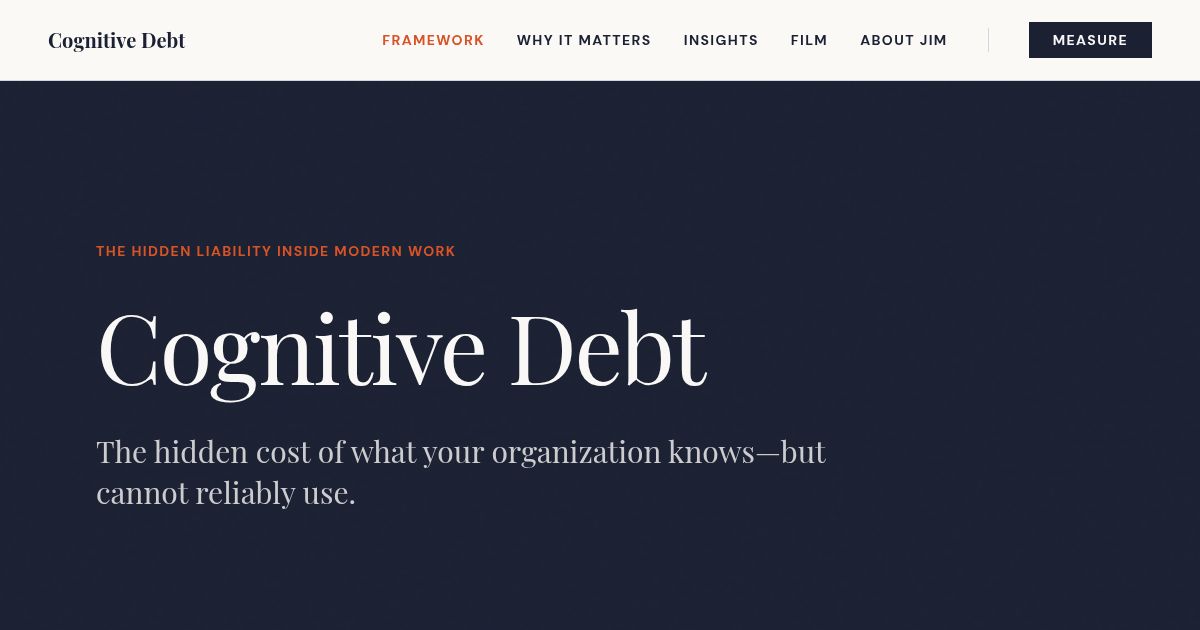
Cognitive Debt framework introduction describing the hidden cost of knowledge an organization cannot reliably use
Editorial Lens

Communication and Cognitive Debt | Preserve Meaning at Work

Learn how missing context, scattered channels, and undocumented decisions create communication debt—and how teams can preserve meaning as work moves.

Read more
Cognitive Debt framework introduction describing the hidden cost of knowledge an organization cannot reliably use
Editorial Lens

Relational Trust and Cognitive Debt | Make Information Usable

Explore how reliable commitments, visible uncertainty, and trustworthy information reduce verification loops and organizational friction.

Also one of the eight Assessment Dimensions.

Read more
Cognitive Debt framework introduction describing the hidden cost of knowledge an organization cannot reliably use
Editorial Lens

Psychological Safety and Cognitive Debt | Surface What Matters

See how the ability to raise uncertainty, errors, and dissent affects organizational memory, decisions, and the cost of hidden context.

Read more
Cognitive Debt framework introduction describing the hidden cost of knowledge an organization cannot reliably use
Editorial Lens

Organizational Alignment and Cognitive Debt | Share the Plan

Learn why shared decision logic, priorities, ownership, and trade-offs matter more than repeated slogans for durable organizational alignment.

Read more
Cognitive Debt framework introduction describing the hidden cost of knowledge an organization cannot reliably use
Editorial Lens

Execution and Cognitive Debt | Turn Decisions Into Work

Understand how unclear ownership, fragile handoffs, and lost decision context slow execution—and how teams can make work state visible.

Read more
Cognitive Debt framework introduction describing the hidden cost of knowledge an organization cannot reliably use
Editorial Lens

Cognitive Capacity at Work | A Cognitive Debt Framework

Explore how fragmented attention, meeting load, and repeated reconstruction consume usable capacity—and why this framework is not a clinical measure.

Read more
Cognitive Debt framework introduction describing the hidden cost of knowledge an organization cannot reliably use
comparison

Cognitive Debt vs Burnout | A Careful Workplace Distinction

Compare an organizational information-friction framework with WHO's occupational description of burnout, without treating either as a diagnosis.

Read more

Quantify your organization's reality

Take the Assessment